FrameMaker Knowledge Hub
• 22 Apr 2026
• 8 views
A practical guide for commuter students on time, participation, belonging, fatigue, and building a strong campus experience despite travel demands.
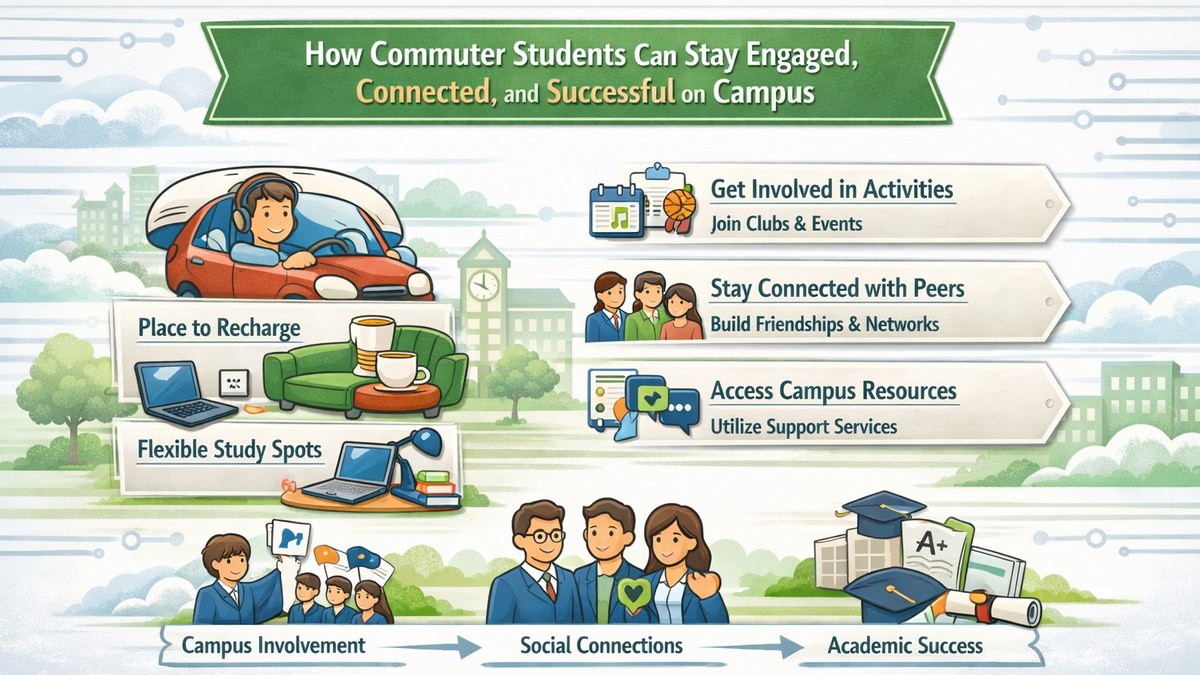
How Commuter Students Can Stay Engaged, Connected, and Successful on Campus
Much of the public imagination around college life is built around residential campuses, hostels, late-night discussions, and constant physical immersion in student communities. Yet a large number of students experience higher education differently. They commute. Some travel short distances. Others spend hours each day on buses, trains, or shared transport. Some combine commuting with family duties, part-time work, or financial constraints. Their university experience is real and valuable, but it often comes with distinctive pressures that institutions and even peers do not fully appreciate.
Commuter students are sometimes seen as less involved or less visible, but this is often a structural issue rather than a motivational one. Travel time, fatigue, limited flexibility, and reduced access to informal campus moments can make participation harder. When institutions design student life mainly around those who remain on campus after class, commuter students may feel peripheral despite attending regularly and working seriously.
This makes commuter student success an important student-life issue. If universities want a truly inclusive campus experience, they must pay attention to students whose relationship with campus is shaped by movement, schedule, and constraint.
The Unique Challenges of Commuter Students
Commuting affects more than logistics. It influences time, energy, identity, and belonging. Students may lose hours each day to travel. They may arrive tired, leave quickly, miss informal networking, avoid evening events, or feel disconnected from peer groups that socialize after class. Bad weather, transport delays, and cost concerns can increase stress further.
Commuter students may also face emotional tension. They are present academically but may feel absent from the social life that defines campus memory for others. Over time, this can reduce participation and weaken a sense of belonging unless students and institutions respond deliberately.
Why Engagement Still Matters
It may seem tempting for commuter students to treat college as a purely transactional experience: attend class, return home, complete requirements, and minimize complexity. While this approach can sometimes feel efficient, it also risks reducing access to the very experiences that enrich learning and opportunity. Engagement matters for commuters too. Faculty interaction, peer connection, mentoring, campus awareness, and selective participation all improve the educational experience.
The goal is not for commuter students to imitate residential life. It is to create a form of campus engagement that works within their reality.
Practical Strategies for Commuter Student Success
1. Use time intentionally
Commuters benefit from careful weekly planning. Travel time should be factored into study schedules, meal timing, assignment work, and rest. Students who ignore commute-related fatigue often overestimate what they can do in a day.
2. Stay on campus strategically
Remaining on campus for one useful hour between classes can be more effective than leaving immediately or wasting the time passively. That hour can be used for revision, assignments, library work, meeting faculty, or attending a student activity.
3. Build at least one campus anchor
A commuter student should ideally have one point of meaningful connection on campus: a club, department association, peer group, mentor, or regular study space. This increases familiarity and reduces the feeling of only passing through.
4. Communicate with peers actively
Because commuters may miss informal conversations, they should maintain class-related contact intentionally. Study groups, academic messaging, shared notes, and planned meetups can help bridge the gap.
5. Protect energy
Travel fatigue is real. Sleep, hydration, snacks, planning for delays, and realistic scheduling all matter. Academic commitment becomes harder when physical energy is consistently depleted.
For Institutions: Inclusion Must Be Designed
Campuses that want to support commuter students should look beyond attendance. Are important events always scheduled late? Are support services available only during narrow hours? Are student communities structured in ways that exclude those who leave earlier? Are there safe and comfortable spaces for commuters to rest, study, and remain on campus between classes?
Inclusion is not achieved merely by admitting commuter students. It is achieved by designing systems that acknowledge their realities.
Commuting and Belonging
Commuter students may sometimes feel that they are less “real” as college students because they are not constantly immersed in campus life. This is a false and damaging idea. Their experience is different, but not lesser. They bring discipline, adaptability, and often significant responsibility to their education. These strengths deserve recognition.
Belonging for commuters may look different. It may come through a few strong peer relationships, regular faculty contact, one meaningful activity, and intentional use of campus resources rather than broad social immersion. That is still belonging.
Conclusion
Commuter students are a major part of the university ecosystem, and their success should be treated as central to student-life planning. Their challenges are not signs of low engagement, but evidence that higher education often assumes one dominant model of campus participation.
With thoughtful planning, realistic routines, and targeted institutional support, commuter students can remain deeply engaged, academically strong, and meaningfully connected to campus life. Success does not require living on campus. It requires being recognized, supported, and included in ways that reflect how students actually live.
References
- NSSE. Annual Results and Student Engagement Insights.
- OECD. Students' Well-being.
- AAC&U. High-Impact Practices.
- JED Foundation. Equity in Mental Health Framework.
- UNESCO. Global Education Monitoring Report.