FrameMaker Knowledge Hub
• 22 Apr 2026
• 5 views
A practical article on help-seeking, academic support, mentoring, counseling, and why students who ask for help early often succeed more consistently.
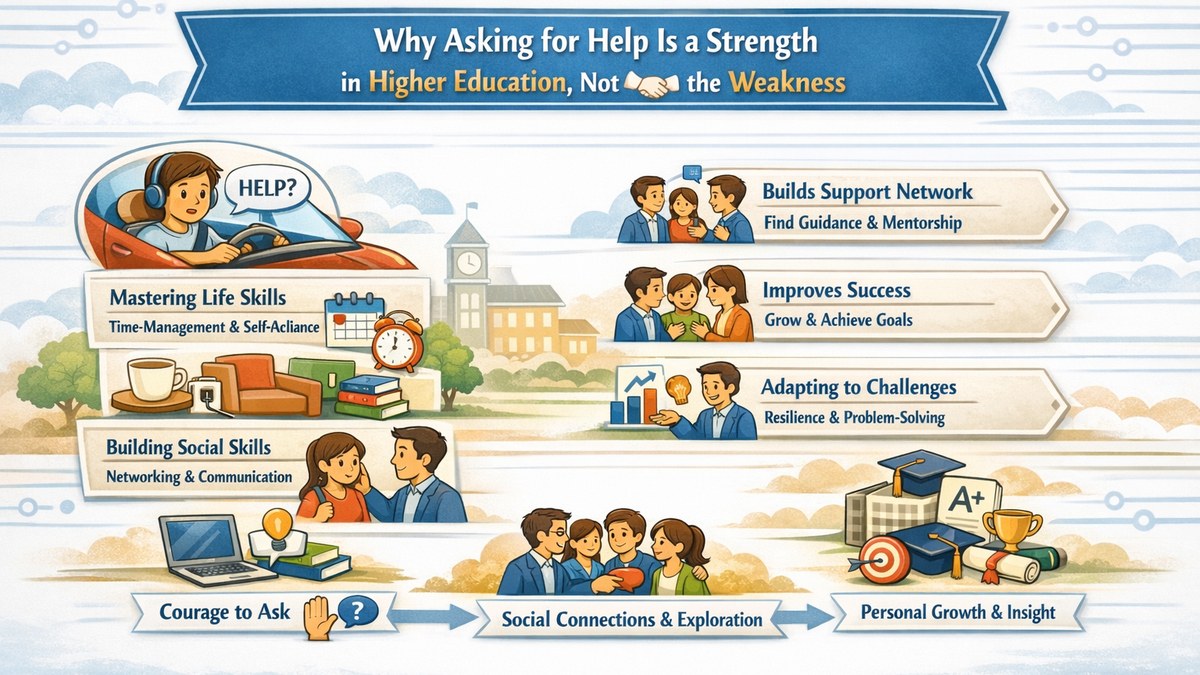
Why Asking for Help Is a Strength in Higher Education, Not a Weakness
Many university students struggle under a harmful assumption: that capable people should be able to manage everything on their own. This belief appears in many forms. Some students hesitate to ask faculty questions because they fear sounding unprepared. Others avoid tutoring because they think support is only for weak students. Some wait too long to seek counseling because they believe stress is simply part of student life and should be tolerated silently. Others do not approach advisors because they assume everyone else already understands how the system works.
In practice, this silence can become one of the biggest barriers to student success. Universities are complex environments. Students are expected to manage content, schedules, deadlines, relationships, wellbeing, and administrative systems at the same time. It is unrealistic to expect that every student will understand or handle every challenge independently from the start. Help-seeking is therefore not a sign of deficiency. It is an essential academic and life skill.
Why Students Delay Asking for Help
Students delay help-seeking for many reasons. Shame is one of the biggest. They worry that asking for help reveals weakness, low intelligence, or poor preparation. Comparison also plays a role. A student may assume that peers are coping better and conclude that their own confusion is unusual. Some students do not know what help exists. Others have had earlier experiences in which seeking help felt dismissive or uncomfortable, making them less likely to try again.
There is also a timing problem. Students often wait until difficulty becomes visible and urgent. By that point, one issue may have multiplied into several: a concept is unclear, attendance has dropped, an assignment is overdue, confidence is low, and stress has intensified. What could have been managed through early guidance now feels much heavier.
What Kind of Help Students May Need
Help in higher education is not limited to one kind of crisis. Students may need support with:
- understanding course content,
- improving writing or presentation skills,
- managing time and deadlines,
- dealing with stress or low mood,
- navigating academic regulations,
- choosing electives or pathways,
- adjusting to hostel or campus life, and
- finding peer or mentor support.
Recognizing that help can be academic, emotional, practical, and relational makes it easier for students to understand that support is part of normal campus life.
Why Early Help Works Better
Early help-seeking prevents escalation. A short conversation with a teacher can clarify a misunderstanding before it becomes a major performance problem. One meeting with an advisor can prevent confusion about deadlines or requirements. A visit to counseling support or a mentor can interrupt patterns of isolation or emotional overload. Early help does not merely solve problems. It often protects confidence.
Students who seek help early are usually more strategic, not less capable. They understand that academic maturity includes knowing when support will strengthen performance.
How Students Can Become More Comfortable Asking for Help
1. Redefine help-seeking
Instead of seeing help as rescue, students should see it as resource use. Universities create services because learning is demanding. Using those services is reasonable and intelligent.
2. Start small
Students do not need to begin with a major disclosure. Asking one academic question, attending one support workshop, or meeting one mentor can make future help-seeking easier.
3. Be specific
When possible, students should identify the issue clearly: “I am unable to structure this assignment,” “I am falling behind in this module,” or “I have been feeling too overwhelmed to focus.” Specificity helps others respond more effectively.
4. Ask before the deadline crisis
The earlier the conversation, the more options usually exist.
5. Keep following up
One conversation may not solve everything. Students often benefit from continued contact, accountability, and repeated support.
The Role of Faculty and Institutions
Help-seeking becomes easier when faculty and institutions normalize it openly. Teachers who invite questions, explain office-hour culture, offer constructive feedback, and speak respectfully about difficulty help reduce the stigma around support. Advisors, counselors, and student affairs teams also contribute when they are visible, approachable, and easy to access.
Campuses should pay attention not only to whether support exists, but also to whether students feel comfortable using it. The best support system is one students trust before they urgently need it.
Help-Seeking and Self-Respect
Some students worry that asking for help will make them dependent. Yet refusing support when it is genuinely needed can do more damage than asking. Self-respect does not mean carrying every burden alone. It means taking your education and wellbeing seriously enough to use available resources wisely.
In fact, help-seeking often strengthens independence. Students learn how to identify problems, communicate clearly, use systems effectively, and take action rather than remain stuck. These are mature and highly transferable skills.
Conclusion
Higher education is not meant to be navigated in silence. The most successful students are not always the ones who appear strongest from a distance. Often, they are the ones who know when to ask questions, when to seek support, and when not to let confusion grow into crisis.
Asking for help is not a weakness in university life. It is part of how students learn, persist, and grow. The earlier students understand this, the more confidently they can move through academic and campus life with resilience rather than isolation.
References
- JED Foundation. A Decade of Improving College Mental Health Systems.
- APA. Student mental health is in crisis. Campuses are rethinking their approach.
- NSSE. Evidence-Based Improvement in Higher Education.
- Strayhorn, T. L. College Students' Sense of Belonging.
- OECD. Students' Well-being.