FrameMaker Knowledge Hub
• 22 Apr 2026
• 7 views
A practical long-form article on the link between mental wellbeing, sleep, support, help-seeking, and sustainable student success in university life.
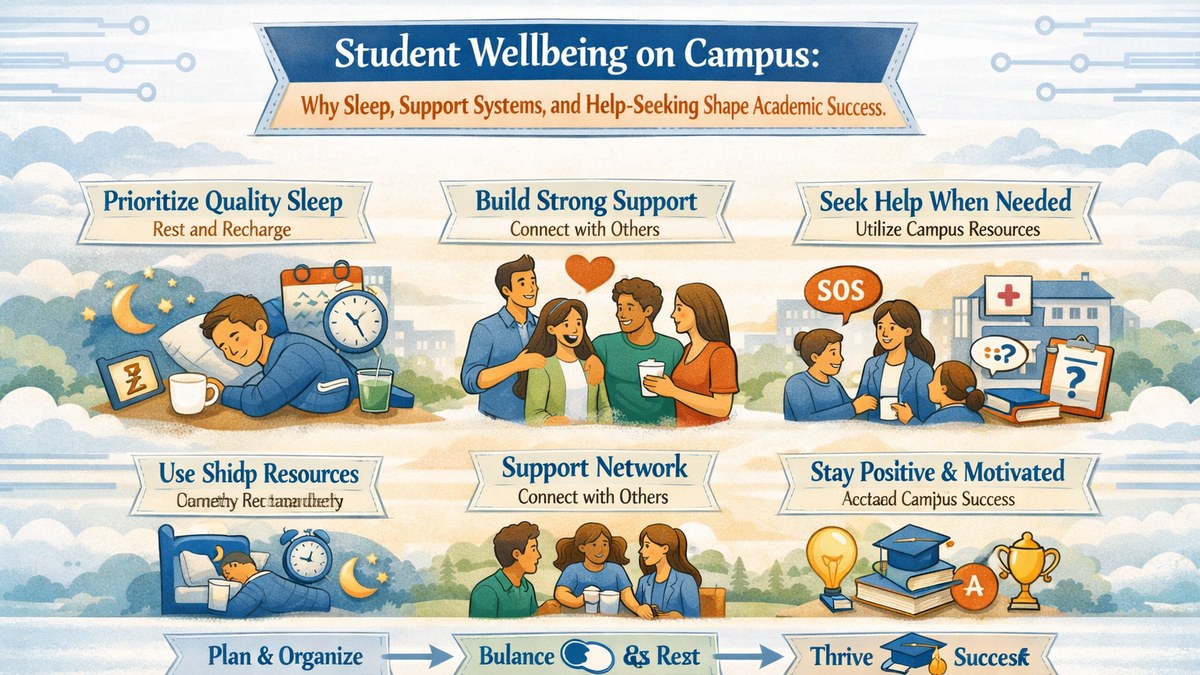
Student Wellbeing on Campus: Why Sleep, Support Systems, and Help-Seeking Shape Academic Success
Student wellbeing is sometimes discussed as though it belongs outside academic life, relevant mainly to counseling centers, wellness weeks, or motivational seminars. In reality, wellbeing is deeply tied to how students learn, attend, concentrate, persist, and participate in campus life. A student who is exhausted, anxious, isolated, or emotionally overwhelmed cannot simply decide to perform at full capacity because an exam timetable demands it.
This is why modern universities increasingly recognize that student success and student wellbeing are not separate agendas. They are intertwined. Sleep affects memory. Stress affects concentration. Isolation affects motivation. Poor emotional health affects attendance, participation, and the willingness to seek help. Conversely, supportive systems, healthy routines, and early intervention can make academic life more sustainable.
What Student Wellbeing Means in Practice
Wellbeing is not the same as constant happiness. It refers to a student's ability to function, cope, connect, and continue learning even when challenges arise. It includes mental, emotional, social, and physical dimensions. For university students, wellbeing is shaped by:
- sleep quality and energy,
- stress management,
- friendship and social support,
- financial and family pressures,
- academic workload,
- sense of belonging, and
- ease of accessing support when needed.
When several of these pressures intensify at once, students may not collapse dramatically. More often, they begin to disengage quietly. They miss classes, delay tasks, stop replying, withdraw from activities, and lose confidence. These early signs should not be ignored.
The Overlooked Power of Sleep
Sleep is one of the most underrated factors in student performance. Many students normalize irregular sleep during exam season or in heavy semesters. While some degree of pressure is unavoidable, chronic sleep disruption affects attention, emotional regulation, recall, and decision-making.
Students who sleep poorly often experience a cycle: they feel tired, so work takes longer; because work takes longer, they sleep later; because they sleep later, they wake more fatigued and less focused the next day. Over time this can create irritability, reduced motivation, and lower academic quality.
Protecting sleep is therefore not a luxury. It is one of the most practical academic strategies available to students.
Why Students Avoid Seeking Help
Many institutions offer support, yet students still delay using it. There are several reasons. Some fear being judged. Some think others are coping better. Some assume their problem is “not serious enough.” Some are unsure where to go. Others believe they should be able to manage alone.
This delay is costly. Problems that are manageable early become heavier with time. A student who seeks guidance when stress first affects concentration is in a far better position than a student who waits until attendance, grades, and confidence have all declined together.
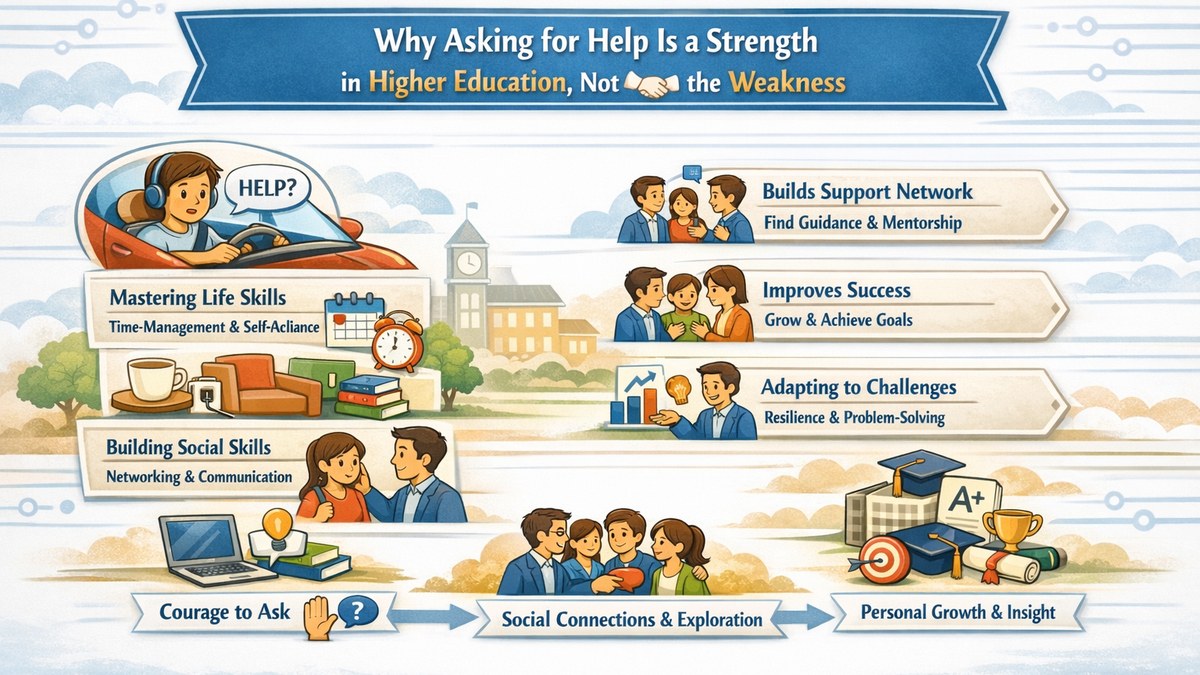
Help-seeking should be understood as part of maturity, not evidence of weakness. Students who use advising, tutoring, counseling, mentoring, or faculty support are often protecting their academic future.
Support Systems That Matter
Wellbeing improves when students have more than one source of support. No single person or office can meet every need. A healthy support system may include:
- one or two trusted friends,
- a mentor or senior student,
- an accessible faculty member,
- an academic advisor,
- family encouragement, and
- formal support services where available.
These supports work best when they are used before crisis. Students should not wait until they feel completely overwhelmed to begin building these connections.
The Campus Environment Matters Too
Wellbeing is not only a private responsibility. Campus culture plays a powerful role. Students are more likely to flourish in environments where communication is clear, faculty are approachable, peer interaction is respectful, and support is visible. They struggle more in environments marked by confusion, stigma, indifference, or constant pressure without guidance.
Institutions that care about student success should ask practical questions: Are students aware of available support? Is the process of seeking help simple? Do teachers normalize healthy routines? Are there safe and inclusive spaces on campus? Are warning signs of disengagement noticed early?
Practical Steps Students Can Take
1. Stabilize sleep as much as possible
Students do not need perfect schedules, but regular sleep and waking times improve concentration and mood significantly.
2. Notice early warning signs
If motivation drops sharply, classes are missed repeatedly, assignments are avoided, or hopelessness increases, that is the time to reach out.
3. Keep at least one trusted conversation open
Isolation magnifies stress. A supportive conversation does not solve everything, but it often prevents problems from becoming internalized and unmanageable.
4. Reduce shame around support
Tutoring, counseling, mentoring, and advising are part of the educational environment. Using them is a strategic choice.
5. Protect basic routines during stressful periods
Meals, hydration, movement, and short breaks may seem secondary, but they help students remain functional under pressure.
Wellbeing and Academic Excellence Are Not Opposites
Some students worry that paying attention to wellbeing will make them less ambitious. The opposite is usually true. Sustainable ambition depends on mental and physical stability. Students can push themselves meaningfully only when they are not operating in a constant state of depletion.
The most effective students are often not those who ignore limits, but those who learn how to work with discipline while respecting the conditions required for concentration, resilience, and recovery.
Conclusion
Student wellbeing should not be reduced to inspirational messaging. It is a serious academic issue. Universities that want stronger retention, healthier campus life, and better student outcomes must recognize that sleep, support systems, belonging, and help-seeking are part of educational effectiveness.
For students, the takeaway is practical: taking care of your wellbeing is not a distraction from success. It is one of the conditions that makes success possible. The strongest academic future is rarely built on exhaustion and silent struggle. It is built on support, routine, self-awareness, and the courage to seek help early.
References
- APA. Why sleep is important and what happens when you don't get enough.
- APA. Student mental health is in crisis. Campuses are rethinking their approach.
- JED Foundation. A Decade of Improving College Mental Health Systems.
- JED Foundation. Equity in Mental Health Framework.
- OECD. Students' Well-being.