FrameMaker Knowledge Hub
• 22 Apr 2026
• 5 views
A practical and research-aware article on how students can manage time, reduce overload, improve concentration, and build academic consistency.
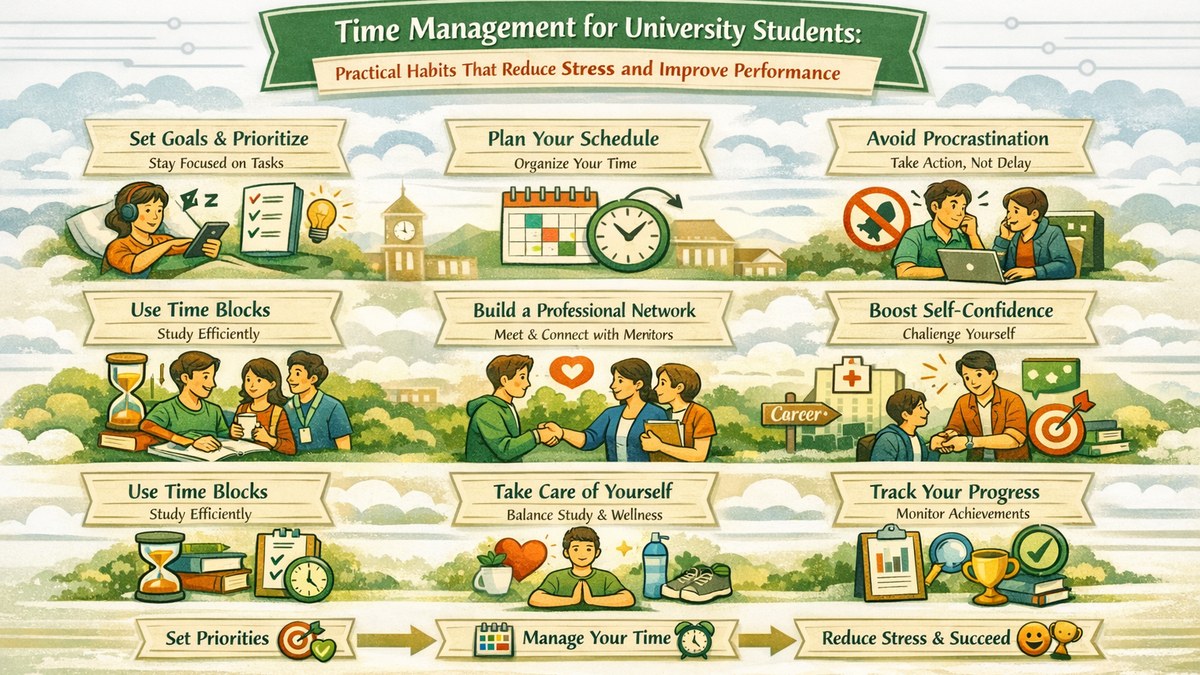
Time Management for University Students: Practical Habits That Reduce Stress and Improve Performance
Time management is one of the most discussed topics in student success, yet it is often presented in ways that are either too simplistic or too motivational to be useful. Students are told to avoid procrastination, stay organized, and work hard. All of that sounds sensible, but it does not explain why time feels so difficult to control in university life.
The real problem is not that students do not value time. The problem is that higher education introduces a complex mix of demands: classes, commuting, assignments, labs, group work, projects, clubs, exams, family responsibilities, part-time work, digital distraction, and emotional fatigue. Under such conditions, poor time management is rarely laziness. More often, it is a mismatch between intention and structure.
Students do not need a perfect productivity system. They need repeatable habits that lower decision fatigue, increase visibility over tasks, and reduce panic. Good time management is less about squeezing every minute for maximum output and more about creating a sustainable rhythm for learning.
Why Time Feels Harder in College Than School
In school, the day is often externally structured. In college, students may have gaps between classes, changing deadlines, multiple instructors, and a stronger expectation of independent study. This creates the illusion of free time. Students see unstructured hours and assume they have plenty of room. Later they discover that reading, note revision, assignment preparation, and presentation work consume far more time than expected.
Another difficulty is cognitive switching. A student may move from lecture to lab, from commute to phone notifications, from group chat to assignment, and from stress to avoidance without ever entering a stable zone of concentration. The day looks full, but deep work remains absent.
The Cost of Disorganized Time
When students do not manage time well, the problem spreads into every area of campus life. They sleep less, attend irregularly, miss submission windows, avoid feedback, postpone difficult work, and study in crisis mode. This increases stress and often creates self-doubt. A student may incorrectly conclude, “I am not capable,” when the real issue is that their routine is not supporting them.
Disorganization also reduces the quality of learning. Last-minute preparation can sometimes produce passable marks, but it weakens retention, limits reflection, and makes higher-order tasks such as writing, analysis, and problem solving more difficult.
What Effective Time Management Actually Looks Like
Effective time management for students has five characteristics:
- visibility: tasks are captured somewhere reliable,
- priority: important work is identified early,
- routine: regular study periods exist,
- realism: time estimates are not overly optimistic, and
- recovery: rest and reset are part of the system.
Without these elements, students tend to operate reactively. With them, they gain a feeling of control even during demanding weeks.
Practical Habits That Work
1. Use one master system
Do not scatter tasks across memory, random papers, multiple apps, and message threads. Use one planner, digital calendar, notebook, or task system as your central reference point.
2. Plan by week before planning by day
Daily to-do lists fail when students have no weekly overview. Begin by seeing lectures, deadlines, travel, revision time, and upcoming submissions in one place. Then decide what each day needs to accomplish.
3. Schedule study blocks, not vague intentions
“I will study later” is not a plan. “I will review biochemistry from 6:00 to 7:00 p.m.” is better. Specificity reduces avoidance.
4. Break major assignments into visible steps
Students procrastinate more when tasks feel undefined. Replace “finish assignment” with smaller steps such as selecting topic, reading sources, drafting outline, writing introduction, revising argument, and formatting references.
5. Protect peak concentration time
Every student has hours in which concentration is naturally stronger. Use those hours for demanding academic work rather than routine browsing or low-value activity.
6. Build buffers
Travel delays, extra reading, technology problems, group coordination, and fatigue all affect performance. Good schedules include margin. A timetable with no buffer becomes fragile immediately.
How to Handle Digital Distraction
Digital life is one of the biggest reasons students lose time without realizing it. Notifications fragment attention. Short-form content trains the brain to prefer novelty over sustained focus. Group chats create the illusion of active engagement while draining concentration.
This does not mean students must abandon technology. It means they should use it more deliberately:
- silence nonessential notifications during study,
- keep the phone physically away during reading or writing,
- use website blockers when needed,
- study in timed intervals with short breaks, and
- avoid starting the day with social media scrolling.
The goal is not punishment. It is attention recovery.
Rest Is Part of Time Management
Students sometimes treat sleep, exercise, meals, and breaks as obstacles to productivity. In fact, these are part of productivity. Concentration, memory, mood regulation, and resilience all decline when students run on exhaustion. Academic discipline becomes harder, not easier, when recovery is ignored.
A sustainable schedule includes:
- regular sleep timing,
- reasonable meal routines,
- short movement breaks,
- time away from screens, and
- protected periods for reset after intense academic days.
What Students Should Do During High-Pressure Weeks
Exam periods and submission-heavy weeks require a more tactical approach. Students should reduce nonessential commitments temporarily, rank tasks by deadline and weight, communicate early in group projects, and avoid trying to recover everything at once. Under pressure, clarity beats intensity.
A useful question is: What are the three most important things I must move forward today? This prevents paralysis and helps students re-enter momentum even when the workload feels overwhelming.
The Deeper Benefit of Managing Time Well
The greatest benefit of time management is not efficiency alone. It is self-trust. When students consistently follow through on small academic commitments, they begin to believe in their own reliability. This reduces anxiety and builds confidence. They stop negotiating with every task. They start working from structure rather than emotion.
That change has long-term value. Students who manage time well tend to participate more fully in campus life because they are not permanently firefighting deadlines. They can attend events, pursue internships, build friendships, and explore opportunities without feeling that everything is slipping out of control.
Conclusion
Time management in university is not a personality trait reserved for naturally organized people. It is a learnable practice. The most successful students are not always the busiest or the most intense. Often they are the ones who make work visible, start earlier than necessary, protect attention, and respect the connection between routine and wellbeing.
Students do not need to master every productivity technique. They need a simple system that helps them show up consistently. Once that happens, performance improves, stress becomes more manageable, and campus life starts to feel less chaotic and more meaningful.
References
- APA. Student mental health is in crisis. Campuses are rethinking their approach.
- APA. Why sleep is important and what happens when you don't get enough.
- NSSE. Evidence-Based Improvement in Higher Education.
- JED Foundation. A Decade of Improving College Mental Health Systems.
- OECD. Students' Well-being.