FrameMaker Knowledge Hub
• 22 Apr 2026
• 5 views
A practical long-form guide to building sustainable study habits, improving concentration, avoiding last-minute panic, and learning more effectively in university.
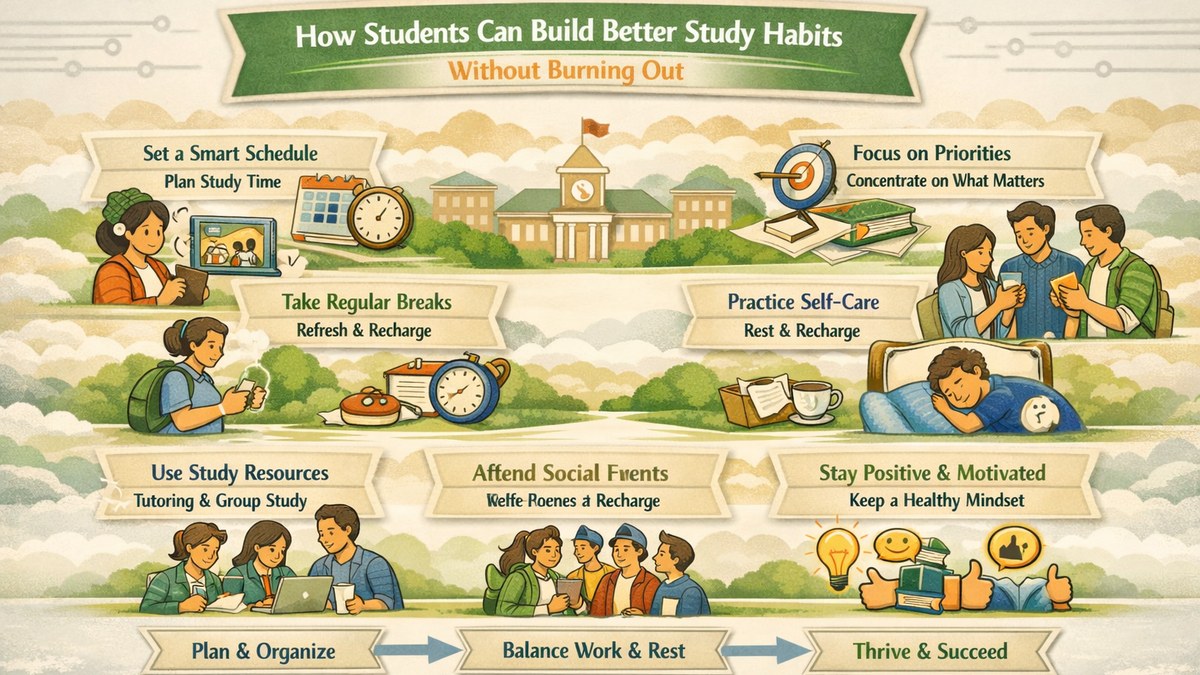
How Students Can Build Better Study Habits Without Burning Out
University students are constantly told to “study harder,” but that advice is incomplete. Hard work matters, yet what often separates successful students from overwhelmed ones is not simply effort. It is the quality, rhythm, and sustainability of their study habits. Students who depend entirely on panic-driven preparation may survive a few assessments, but they usually pay for it with stress, weak retention, poor sleep, and declining confidence. Students who build stable study habits, by contrast, create a stronger foundation for performance and wellbeing at the same time.
Study habits are not about becoming robotic or over-disciplined. They are about reducing friction between intention and action. Most students already know what they should do in a general sense: attend class, revise regularly, finish work early, and prepare well for assessments. The challenge is that student life is full of interruptions, changing schedules, digital distractions, emotional fatigue, and competing priorities. Without a workable system, even good intentions collapse under daily pressure.
This is why study habits matter so much. Strong habits convert academic effort from an occasional emergency into a repeatable process. Once a student develops even a few consistent practices, learning becomes less chaotic and more cumulative.
Why Good Intentions Are Not Enough
Many students begin a semester with energy and optimism. They buy notebooks, make plans, and promise themselves they will stay organized this time. Yet after a few weeks, lectures accumulate, deadlines overlap, and routines weaken. Students then start operating reactively instead of intentionally. They revise only when tests are near. They write assignments close to the deadline. They reread material passively and mistake familiarity for mastery.
The problem is not usually a lack of seriousness. It is that students often rely on motivation instead of systems. Motivation rises and falls. Habits are what carry students on the days when motivation is low.
What Effective Study Habits Look Like
Effective study habits are simple enough to repeat, strong enough to reduce stress, and flexible enough to survive a difficult week. They usually include:
- consistent class attendance,
- same-day or next-day review of lecture material,
- weekly planning for deadlines and revision,
- breaking large tasks into smaller steps,
- active recall instead of passive rereading,
- scheduled breaks and sleep protection, and
- early use of help when confusion appears.
Students often imagine study success as the result of long, intense sessions. In reality, shorter, regular, focused sessions are often more powerful than irregular marathon efforts.
The Difference Between Studying and Looking Busy
One of the biggest traps in college is confusing visible effort with meaningful learning. Highlighting entire pages, rewriting notes endlessly, watching hours of videos without testing understanding, or sitting with books open while checking the phone repeatedly may feel productive, but these activities often produce weak retention.
Real studying involves mental effort. It requires students to retrieve ideas, explain concepts in their own words, connect topics, solve problems, and identify what they do not yet understand. This is harder than passive review, but it is also far more effective.
Practical Habits Students Should Build
1. Review within 24 hours
After each lecture, spend a short period reviewing the key ideas, cleaning up notes, and identifying unclear points. This prevents the accumulation of confusion and makes later revision easier.
2. Study in blocks
Students do not need to sit for six hours continuously. Focused study blocks of 30 to 60 minutes with short breaks can be highly effective, especially when distractions are controlled.
3. Use active recall
Close the book and test yourself. Summarize the topic from memory, solve a problem, write the steps of a process, or explain the concept aloud. Learning deepens when the brain has to retrieve information rather than merely reread it.
4. Space revision over time
Spacing is more effective than cramming. Reviewing content repeatedly over several days or weeks improves long-term retention and reduces last-minute overload.
5. Start assignments early in small steps
Students often delay assignments because the task feels large and undefined. Dividing work into reading, outlining, drafting, revising, and formatting reduces avoidance.
6. Protect sleep
Students sometimes sacrifice sleep in the name of dedication. Yet sleep supports memory, concentration, and emotional regulation. Exhaustion weakens the very learning students are trying to improve.
Why Burnout Happens
Burnout does not result only from having too much work. It often arises from a pattern of pressure without recovery. Students who constantly postpone, then panic, then overwork, then recover briefly, and then repeat the cycle place themselves under continual strain. Over time, this damages motivation and makes even simple tasks feel heavy.
Burnout is also fed by perfectionism. Some students delay beginning because they want ideal conditions, a perfect plan, or a perfect first draft. This creates internal pressure that slows progress. A good-enough start is often better than a perfect plan that never turns into action.
How Students Can Make Study More Sustainable
- set realistic daily targets instead of impossible ones,
- plan one week at a time,
- keep a single trusted system for tasks and deadlines,
- study in environments that reduce distraction,
- mix difficult and easier tasks to maintain momentum, and
- treat breaks as recovery, not as failure.
Students should also learn to notice when their routine is slipping. Missing one planned session is not a crisis. What matters is restarting quickly instead of waiting for the next Monday, next month, or next exam cycle.
The Role of Faculty, Peers, and Campus Support
Good study habits are personal, but they do not develop in isolation. Faculty who explain expectations clearly, peers who encourage steady preparation, mentors who share practical strategies, and academic support centers that teach note-making, writing, and revision methods all contribute to stronger learning habits.
Universities should not assume students arrive already knowing how to study effectively at the higher-education level. Many students need explicit guidance in transitioning from school-style preparation to independent academic learning.
Conclusion
Students do not need extreme productivity systems to succeed. They need repeatable habits that make learning more structured, active, and humane. Sustainable study is not built on guilt, fear, or last-minute panic. It is built on routine, clarity, and self-awareness.
When students develop better study habits, they do more than improve marks. They reduce stress, gain confidence, and create a more stable university experience. Over time, those habits become one of the strongest foundations for long-term student success.
References
- Brown, Roediger, and McDaniel. Make It Stick: The Science of Successful Learning.
- Dunlosky et al. Improving Students’ Learning With Effective Learning Techniques.
- APA. Why sleep is important and what happens when you do not get enough.
- NSSE. Evidence-Based Improvement in Higher Education.
- AAC&U. High-Impact Practices.