FrameMaker Knowledge Hub
• 22 Apr 2026
• 4 views
An article explaining how clubs, volunteering, mentoring, leadership roles, and campus participation contribute to student success and employability.
Beyond the Classroom: How Campus Involvement Builds Confidence, Skills, and Career Readiness
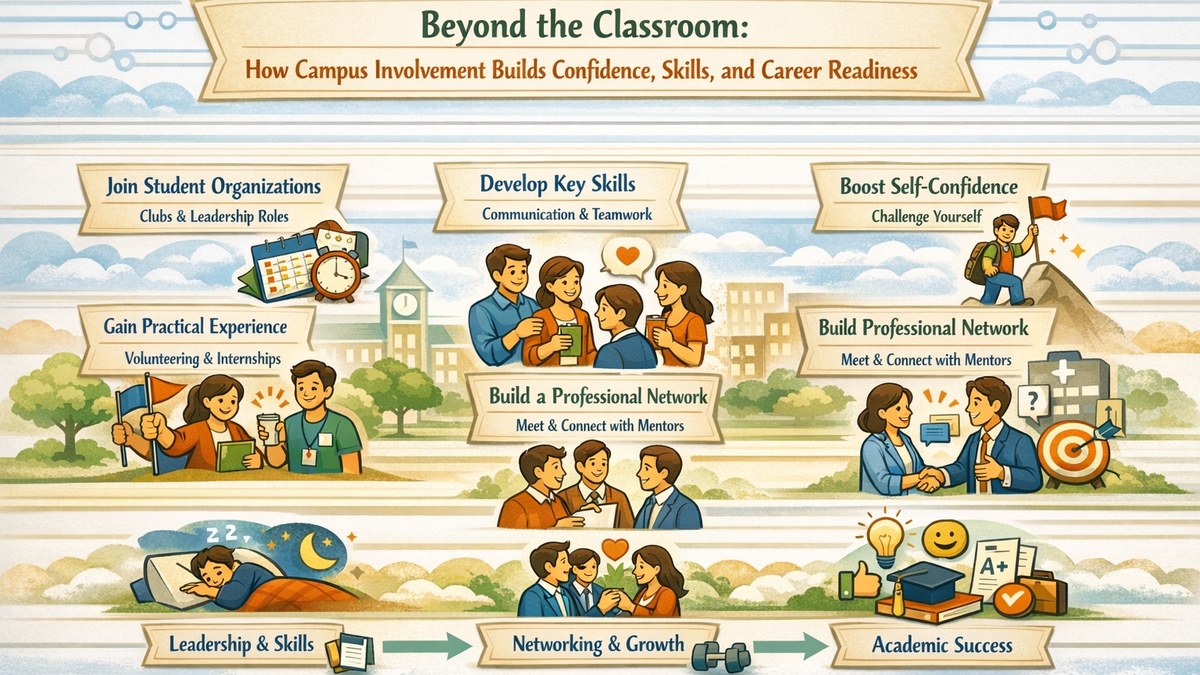
Many students think of campus life as something separate from academic success. They treat clubs, volunteering, student committees, competitions, events, and leadership roles as optional extras that matter only after coursework is under control. This view is understandable, especially in demanding programs, but it misses an important truth: purposeful campus involvement is often one of the strongest pathways to confidence, belonging, communication skill, and long-term employability.
Higher education is not designed merely to transfer subject content. It is also meant to develop judgment, collaboration, responsibility, initiative, and the ability to function in diverse teams and real-world settings. These capacities are not always fully formed through lectures and exams alone. They are often sharpened in the co-curricular space, where students must organize, communicate, coordinate, and contribute actively.
Why Involvement Matters
Campus involvement helps students convert passive attendance into active membership. A student who only goes from class to home may remain technically enrolled but psychologically disconnected. Participation in campus activities can change that by creating routine contact, identity, and purpose beyond assessment cycles.
Students who engage meaningfully in campus life often gain:
- stronger social confidence,
- better communication skills,
- greater sense of belonging,
- exposure to teamwork and leadership,
- practical problem-solving experience, and
- a more compelling profile for internships and jobs.
These gains are especially important in today's environment, where employers increasingly value adaptability, initiative, collaboration, and professional presence alongside academic knowledge.
What Counts as Meaningful Campus Involvement?
Meaningful involvement does not require holding a high-profile leadership title. Students can benefit from many forms of participation, including:
- department associations,
- cultural or literary clubs,
- sports and fitness groups,
- technical societies and hackathons,
- community service or social impact work,
- peer mentoring and tutoring,
- student magazines or media teams,
- event volunteering, and
- innovation, entrepreneurship, or research forums.
What matters is not prestige but engagement. A student who consistently contributes in a modest role may grow more than a student who holds a title but rarely participates seriously.
How Involvement Builds Transferable Skills
Communication
Student organizations require members to speak, write messages, coordinate tasks, listen, and clarify misunderstandings. These are professional communication skills in action.
Teamwork
Group projects in class are one form of teamwork, but campus activities add something different: collaboration across interests, personalities, and levels of commitment. Students learn how to negotiate, encourage participation, and manage conflict.
Leadership
Leadership is not only about being president or secretary. It includes taking initiative, solving problems, following through, and supporting others reliably.
Time balancing
Students involved in campus life often become more intentional about planning because they must manage both academic and co-curricular commitments.
Confidence
Repeated participation gradually reduces hesitation. Students who once felt invisible begin to speak, host, organize, and represent their institutions with more confidence.
High-Impact Learning Beyond Formal Coursework
Research on student engagement has long shown that educational quality is not measured only by classroom contact hours, but also by whether students participate in meaningful learning practices. Experiences that require reflection, collaboration, and application tend to deepen learning. Campus activities can function in similar ways when they are purposeful and well-supported.
For example, organizing a student event teaches planning, logistics, communication, budgeting, and contingency handling. Volunteering can strengthen empathy, public interaction, and civic awareness. Participating in a debate or competition sharpens preparation and articulation. Peer mentoring develops patience, listening, and responsibility. These experiences enrich academic identity rather than distract from it.
Campus Involvement and Career Readiness
Students often ask how to stand out in interviews when many candidates have similar degrees. One answer is evidence of applied skill. Recruiters and interviewers notice examples that show initiative and responsibility. A student who can explain how they coordinated a college event, handled a conflict in a team, mentored juniors, led a campaign, or contributed to a social project often presents a stronger profile than someone who can discuss coursework only in abstract terms.
Campus involvement also expands professional imagination. Students meet seniors, alumni, guest speakers, faculty advisors, and peers from other departments. This broadens their understanding of career possibilities and gives them more language to describe their own strengths.
How to Participate Without Hurting Academics
One valid concern is overcommitment. Campus life helps only when students participate intelligently. A few principles help:
- start with one meaningful activity rather than many,
- choose roles that genuinely interest you,
- be reliable in small commitments before seeking larger ones,
- protect class attendance and assignment deadlines first, and
- review each semester whether your involvement is enriching or draining you.
The goal is not to stay busy for appearance. The goal is to participate in ways that build growth and connection.
For Students Who Feel Shy or Unsure
Many students assume campus involvement is only for extroverts. This is not true. Shy students often thrive in structured activities because roles reduce social uncertainty. Volunteering at registration desks, helping with backstage logistics, joining small discussion groups, or contributing to editorial or technical work can be excellent entry points.
Students do not need to become loud personalities. They need opportunities to become visible through contribution.
What Institutions Should Encourage
Universities should make campus involvement accessible rather than leaving it to informal networks. This means communicating opportunities clearly, diversifying participation formats, recognizing student contribution, and ensuring that clubs and events do not become socially closed spaces. Institutions that value student success should view co-curricular engagement as part of the developmental ecosystem, not as a side attraction.
Conclusion
The best campus experiences are not created by infrastructure alone. They are created when students participate in communities of action. Through clubs, volunteering, mentoring, cultural activities, student leadership, and collaborative initiatives, students build the personal and professional capacities that make university life richer and more future-ready.
Academic achievement remains essential, but students should not underestimate the educational power of involvement beyond the classroom. In many cases, it is precisely these experiences that help students become more articulate, more resilient, more employable, and more connected to the institution they are a part of.
References
- AAC&U. High-Impact Practices.
- NSSE. Survey Instruments and Engagement Insights.
- NSSE. Evidence-Based Improvement in Higher Education.
- UNESCO. Leadership in Education.
- OECD. Students' Well-being.