FrameMaker Knowledge Hub
• 25 Apr 2026
• 1 views
A scholarly long-form article on the pressure universities face to balance degree value, transferable skills, employability, and long-term educational purpose.
Skills, Degrees, and the Future of Value: How Universities Can Stay Relevant in a Changing Economy
Higher education is increasingly being asked a demanding and sometimes uncomfortable question: what exactly should a university degree deliver in a world where work changes rapidly, technologies evolve continuously, and employers seek evidence of adaptable skills as much as formal qualifications? This question does not render degrees obsolete, nor does it imply that universities should abandon their deeper educational mission. It does, however, place strong pressure on institutions to explain value more clearly and to connect learning more convincingly to uncertain futures.
In 2026, the challenge is not whether universities should choose between degrees and skills. It is how they can integrate both. A serious university education should still develop intellectual depth, critical reasoning, ethical judgment, disciplinary understanding, and civic imagination. At the same time, students and employers increasingly expect graduates to demonstrate communication, problem solving, collaboration, digital fluency, resilience, and the capacity to continue learning throughout their lives.
The future relevance of higher education therefore depends on whether institutions can connect long-term educational purpose with short- and medium-term capability. Universities that treat these as opposing agendas risk becoming either narrowly vocational or insufficiently responsive. The more credible path lies in thoughtful integration.
Why the Value Question Has Intensified
Several forces have made questions of educational value more prominent. The first is economic pressure. Students and families are more attentive to the cost of education and more likely to ask what forms of opportunity, security, and personal development a degree is expected to support. The second is labor-market uncertainty. As technologies change tasks and industries evolve, students seek preparation that feels flexible rather than narrowly fixed.
A third factor is the increasing visibility of skills discourse. Employers, policy bodies, and public commentary often emphasize competencies such as communication, analytical thinking, teamwork, adaptability, and digital capability. Reports on the future of work regularly underscore that technical skills alone are not sufficient. What matters is the ability to combine knowledge with judgment and the capacity to learn continuously.
These developments place universities under dual scrutiny: they must preserve academic integrity and intellectual breadth while also demonstrating that graduates leave with capabilities that matter beyond the classroom. The institutions that struggle are often those that present degrees as self-evidently valuable without making that value legible in contemporary terms.
Why Degrees Still Matter
Despite the pressure around skills, the degree remains important. A university degree still signals extended engagement with structured learning, disciplinary method, evidence-based reasoning, and sustained academic effort. It can also cultivate forms of thought that are difficult to reduce to short-term training: conceptual depth, interpretive ability, ethical awareness, research literacy, and the capacity to understand complexity.
These qualities matter in a changing economy precisely because the future is uncertain. Narrow training may meet a current market need but become outdated quickly. Deep learning, by contrast, can support adaptability across changing contexts. Universities should therefore avoid the mistake of defending the degree only in traditional or symbolic language. The stronger argument is that rigorous higher learning develops human capacities that remain valuable even as specific tools and roles evolve.
At the same time, institutions should not assume that this value is automatically visible to students or employers. Universities need to articulate more clearly how academic work develops transferable capability.
Why Skills Matter More Openly Now
Skills have become more prominent not because knowledge no longer matters, but because the ability to apply knowledge is under closer scrutiny. Employers want graduates who can communicate with clarity, collaborate across difference, interpret information critically, solve unfamiliar problems, and continue learning. Students want to know how their studies connect to opportunity. Public discourse increasingly asks whether education systems are producing not only credentials but usable capability.
Importantly, the skills discussion should not be interpreted narrowly. Skills are not just technical tasks or job-specific routines. Many of the most valuable capabilities are broad and portable: writing well, speaking persuasively, analyzing evidence, managing projects, working in teams, adapting to new tools, and acting ethically under uncertainty. Universities are well placed to develop these capacities, but only if they bring them into clearer view.
The False Choice Between Education and Employability
One of the more damaging tendencies in higher-education debate is the framing of deep education and employability as competing agendas. According to this view, universities must either preserve intellectual seriousness or become practical and market-facing. This is a false choice. The real challenge is to design educational experiences in which theory and application strengthen each other.
A student studying history can develop research discipline, argumentation, evidence evaluation, and writing capability. A student in engineering can develop teamwork, ethics, systems thinking, and communication alongside technical expertise. A student in health sciences can cultivate empathy, professional judgment, and interdisciplinary collaboration. In each case, employability grows not from reducing the curriculum to training, but from helping students understand and demonstrate the broader capabilities their education develops.
What universities need, then, is not simplification but articulation. They must make educational value visible without diminishing its richness.
What Relevance Looks Like in Practice
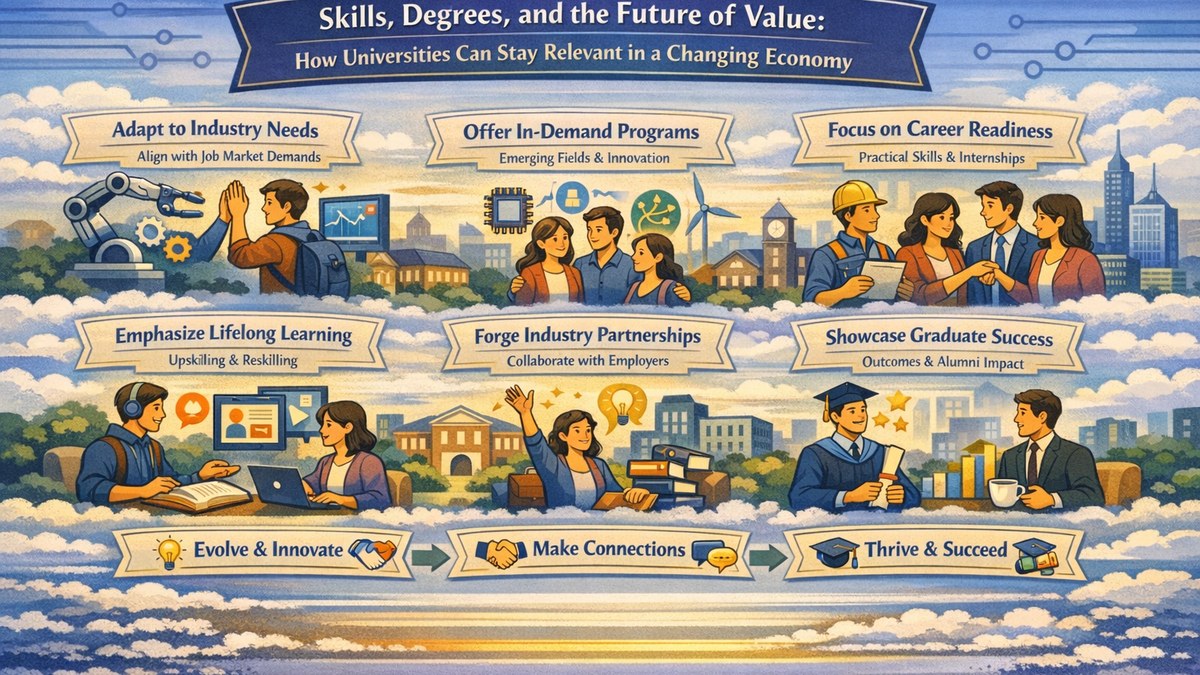
Relevance in higher education does not require turning every course into vocational instruction. It does require stronger bridges between learning and future application. These bridges may include internships, project-based learning, problem-based assignments, research opportunities, portfolios, reflective assessment, community engagement, and co-curricular participation that helps students practice professional capability.
Universities can also integrate career development more deliberately across the student journey rather than confining it to final-year placement activity. Students benefit when they learn early how to identify and describe the skills they are building. This includes learning how to translate academic experience into language that employers, scholarship panels, and professional networks can understand.
Digital and AI literacy are now part of this relevance agenda as well. Graduates increasingly need to work in environments shaped by automation, data, and digitally mediated collaboration. Universities that ignore this reality risk preparing students for an economy that no longer exists.
Lifelong Learning and the Degree After Graduation
Another major dimension of value in 2026 is the growing importance of lifelong learning. A degree is increasingly understood not as the final educational qualification a person will ever need, but as part of a longer learning trajectory. This has implications for how universities think about curriculum and institutional identity. Graduates may return for microcredentials, further study, digital upskilling, or specialized professional development.
In this sense, the most future-ready universities are those that position themselves not only as places where students earn degrees, but as institutions that support learning across longer spans of life. This does not weaken the degree. It situates it within a broader ecology of continuing capability development.
The Role of Public Trust
The value of degrees is also tied to trust. Students and employers must believe that higher education maintains standards, develops real capability, and awards qualifications that still carry meaning. If universities respond to pressure simply by making vague claims about employability without demonstrating serious educational outcomes, trust may weaken. Conversely, if institutions defend tradition without adapting to changing conditions, they may appear detached from reality.
Trust is strongest when institutions can show that they remain intellectually rigorous while also being responsive to the world students enter after graduation. This balance is difficult, but it is essential.
Conclusion
The future of higher education will not be secured by rejecting skills discourse, nor by abandoning the degree in favor of narrower forms of training. It will be secured by institutions that can integrate deep learning with visible capability, long-term intellectual development with practical readiness, and academic integrity with relevance to a changing economy.
Universities remain uniquely valuable because they can cultivate not only what students know, but how they think, judge, create, collaborate, and continue learning. The task in 2026 is to make that value clearer, more demonstrable, and more closely connected to the realities students face. Relevance will not come from simplification. It will come from integration done well.
References
- OECD. Education at a Glance 2025, 2025.
- World Economic Forum. The Future of Jobs Report 2025, 2025.
- UNESCO. Transforming higher education: a global roadmap for the future, 2026.
- EDUCAUSE. 2025 Students and Technology Report, 2025.