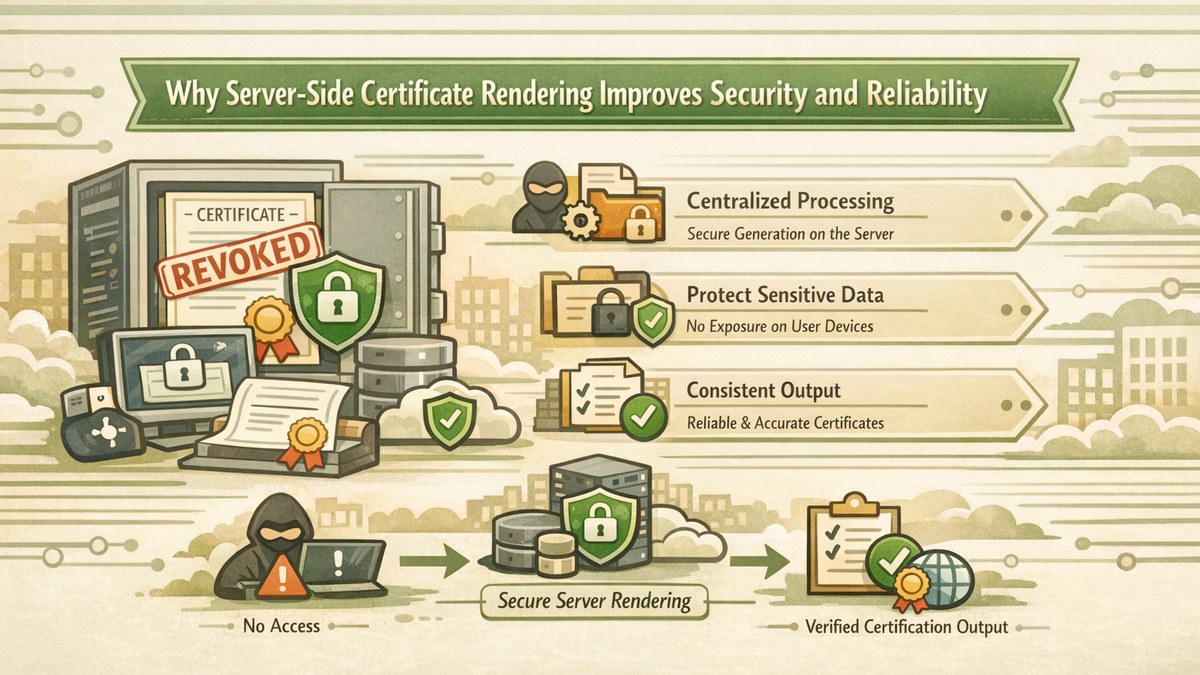
How Server-Side Certificate Rendering Improves Security and Reliability
The adoption of digital credentialing systems has significantly transformed how institutions issue, manage, and verify certificates. As organizations transition from manual or semi-digital processes to fully automated platforms, the underlying architecture of certificate generation becomes a critical determinant of system security and reliability. Among the available approaches, server-side certificate rendering has emerged as a widely accepted best practice in secure credential systems.
Certificate rendering can broadly be categorized into two models: client-side rendering, where certificate generation occurs within the user’s browser, and server-side rendering, where the process is executed within a controlled backend environment. While client-side methods may offer perceived responsiveness, they inherently expose generation logic and data handling mechanisms to the end user, thereby increasing the risk of manipulation. Server-side rendering, in contrast, centralizes control and ensures that all certificate outputs are derived from validated and authoritative data sources.
Architectural Foundations of Server-Side Rendering
In a server-side model, certificate generation is performed within a secured application layer that interacts directly with institutional databases. The rendering engine applies predefined templates, positional configurations, typography rules, and validation checks before producing the final certificate output. The user is provided only with a rendered artifact—typically a PDF or image—without access to the underlying generation logic.
This architectural separation between data, logic, and presentation aligns with established principles in secure system design, particularly those emphasizing controlled execution environments and minimal exposure of critical processes [1].
Security Implications
The primary advantage of server-side rendering lies in its ability to mitigate multiple classes of security risks commonly associated with client-side execution.
1. Protection Against Data Manipulation
Client-side rendering exposes data fields and generation scripts to the browser, making them susceptible to tampering. Server-side systems eliminate this exposure by ensuring that all certificate attributes are derived directly from verified backend records.
2. Prevention of Unauthorized Template Alteration
Certificate templates, including layout, branding, and formatting rules, remain securely stored within the server environment. This prevents unauthorized modifications that could otherwise compromise the visual and structural integrity of certificates.
3. Reduced Attack Surface
By minimizing the amount of executable logic on the client side, server-side rendering reduces the system’s exposure to common web-based vulnerabilities such as script injection and data interception.
Reliability and Consistency Advantages
Beyond security, server-side rendering ensures a high degree of consistency and operational reliability.
1. Standardized Output Across Environments
Certificates generated on the server are independent of client device configurations, browser variations, or rendering inconsistencies. This guarantees uniform presentation across all recipients.
2. Centralized Template Management
Institutions can update certificate templates, branding elements, or formatting rules centrally, ensuring that all subsequent certificates reflect the latest standards without requiring user intervention.
3. Deterministic Rendering
Server-side processes produce predictable and reproducible outputs, which is essential for auditability and long-term record validation.
Integration with Broader Credential Ecosystems
Server-side rendering also facilitates seamless integration with complementary systems such as verification portals, QR-based validation mechanisms, and secure access workflows. By maintaining a centralized source of truth, institutions can ensure that certificate data remains synchronized across issuance, storage, and verification layers.
In large-scale deployments—such as academic conferences, university programs, or professional certification bodies—this integration capability becomes particularly important for maintaining system coherence and operational efficiency.
Operational and Governance Benefits
From an institutional perspective, server-side rendering supports stronger governance and lifecycle management. Administrators can regenerate certificates, correct data discrepancies, or apply updated templates without relying on end users. Additionally, server-side logs provide traceability for each certificate generation event, supporting compliance, audits, and dispute resolution processes.
Conclusion
Server-side certificate rendering represents a foundational component of secure and reliable digital credential systems. By centralizing control, protecting rendering logic, and ensuring strict data validation, it addresses both technical and operational challenges associated with certificate issuance. As digital credentials continue to gain prominence across academic and professional domains, server-side rendering will remain essential for preserving trust, ensuring consistency, and enabling scalable credential management frameworks.
References (Indicative)
[1] Principles of Secure System Design – Controlled Execution and Data Integrity Models
[2] Digital Credentialing Frameworks in Higher Education and Professional Certification Systems