Digital Certificates: A Smarter Way to Issue, Verify and Protect Credentials
In a digital-first world, certificates are no longer limited to printed sheets distributed at the end of a course, workshop, seminar, or conference. Organizations today require faster, safer, and more professional ways to recognize participation and achievements. As events, education, and professional learning increasingly move online, traditional certificate processes struggle to keep pace with the scale and expectations of modern participants.
This is where digital certificates have become an essential solution. By replacing manual issuance and paper-based workflows with structured digital systems, institutions can deliver credentials efficiently while maintaining reliability, security, and professional presentation.
Whether the goal is to recognize participation, training completion, academic achievement, volunteer contribution, or professional development, digital certificates provide a modern workflow that is scalable, verifiable, and accessible from anywhere.
What Are Digital Certificates?
A digital certificate is an electronic credential issued to confirm that a person has completed a course, attended an event, received an award, contributed to a program, or achieved a recognized milestone. Unlike traditional paper certificates, digital certificates are designed specifically for online access, secure download, easy sharing, and independent verification.
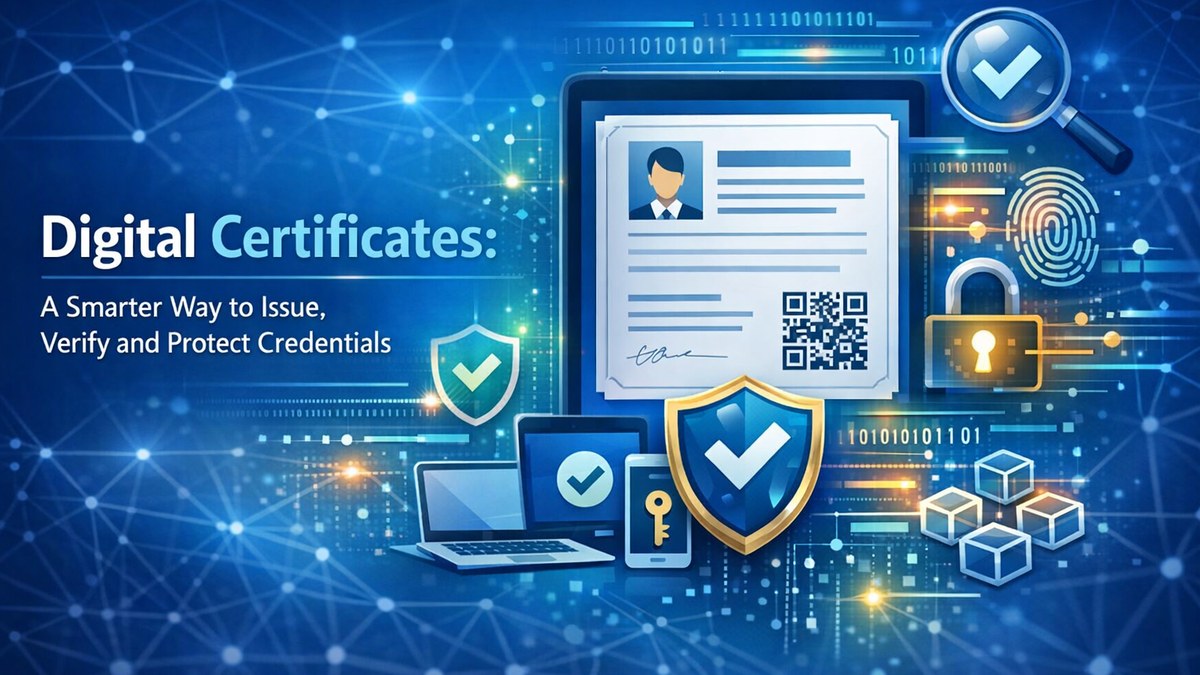
Digital certificates typically include features such as unique certificate identifiers, QR codes, downloadable PDF formats, organization branding, secure retrieval workflows, and verification links. These elements make them significantly more practical and reliable than traditional printed certificates.
Because they are stored digitally, recipients can retrieve their certificates when needed without relying on physical copies or manual record searches. This accessibility greatly improves both the efficiency of certificate management and the experience of recipients.
Why Digital Certificates Matter
Manual certificate issuance may work for a very small group, but it quickly becomes difficult as the number of recipients grows. Designing certificates one by one, verifying names, printing documents, collecting signatures, scanning files, emailing attachments, and maintaining historical records requires considerable time and effort.
Digital certificates simplify this entire process by turning certificate issuance into a structured workflow. Instead of repeating the same manual tasks for every participant, organizations can generate certificates automatically using structured data and reusable templates.
This shift not only improves operational efficiency but also ensures that certificates are delivered faster and with greater consistency. At the same time, digital systems help maintain long-term records, allowing recipients to retrieve their credentials even years after the event or program.
Key Benefits of Digital Certificates
1. Faster Issuance
One of the most significant advantages of digital certificates is the speed of issuance. Instead of preparing each certificate individually, organizations can generate certificates in bulk for hundreds or even thousands of participants within minutes.
This capability is particularly valuable for conferences, workshops, webinars, faculty development programs, online learning initiatives, and professional training sessions where participant numbers are often large.
2. Better Accuracy
When certificate content is linked directly to structured participant data, the risk of spelling errors, duplication, and manual mistakes is greatly reduced. Participant names, roles, event titles, and institution details can be pulled directly from verified records.
This ensures that every certificate follows consistent formatting and contains accurate information.
3. Easier Access for Recipients
Participants can download their certificates through secure access workflows such as email verification, OTP-based authentication, tokenized links, or event-specific retrieval pages. This approach eliminates the need for staff to manually resend certificates or locate archived records.
Recipients benefit from the flexibility of retrieving their credentials whenever they need them.
4. Stronger Institutional Branding
Digital certificates allow organizations to incorporate logos, event titles, organization names, signatures, themed templates, and custom layouts. These branding elements help create certificates that reflect the professionalism and identity of the issuing institution.
When recipients share their certificates on professional networks or digital portfolios, these branding elements reinforce the visibility and credibility of the organization behind the credential.
5. Reliable Verification
One of the most important advantages of digital certificates is verifiability. Features such as QR codes, certificate IDs, verification pages, and secure validation workflows make it possible for third parties to confirm whether a certificate is genuine.
This verification capability increases trust for employers, academic institutions, and other organizations reviewing credentials.
6. Lower Administrative Burden
By automating certificate generation and distribution, digital systems significantly reduce administrative workload. Staff members no longer need to spend time manually generating certificates, responding to repeated requests, or managing duplicate copies.
A centralized certificate system simplifies the entire credential management process.
7. Cost and Resource Efficiency
Digital certificates eliminate many costs associated with traditional paper certificates, including printing, physical storage, courier services, and reissuance of lost copies. Over time, this creates a more efficient and sustainable model for credential management.
Common Use Cases for Digital Certificates
Digital certificates are now widely used across education, professional training, and event ecosystems. Some common use cases include:
- Academic conferences and research symposiums
- Workshops, seminars, and webinars
- Faculty development programs
- Student participation and achievement recognition
- Online courses and skill certification programs
- Internship and project completion certificates
- Corporate training and employee learning programs
- Volunteer, committee, and organizer acknowledgements
- Competitions, hackathons, and award recognitions
These use cases demonstrate the versatility of digital certificates across a wide range of institutional and professional contexts.
What Makes a Good Digital Certificate System?
A digital certificate is not merely a downloadable PDF file. Behind every effective certificate workflow is a reliable system that manages design, participant data, security, delivery, access, and verification.
A well-designed digital certificate platform should ideally support:
- Bulk certificate generation
- Reusable templates for multiple events
- Organization-specific branding
- Secure recipient authentication
- QR code or lookup-based verification
- Download-friendly certificate formats
- Repeat access for archived certificates
- Administrative controls and activity visibility
The best platforms do not simply generate certificates—they provide a complete ecosystem for issuing and managing digital credentials.
Security and Trust
Trust is central to certificate issuance. A certificate should look professional, but it must also be protected against misuse, duplication, or unauthorized modification.
Modern digital certificate systems address this challenge by incorporating secure retrieval mechanisms, unique identifiers, event-linked records, and verification workflows. These features ensure that certificates can be validated reliably when presented in professional or academic contexts.
By maintaining strong security and verification standards, institutions can protect both their reputation and the value of the credentials they issue.
The Recipient Experience
Today’s participants expect convenience and accessibility. They want certificates that can be accessed on both mobile and desktop devices, downloaded easily, and shared with employers, institutions, or professional networks.
A well-designed digital certificate experience ensures that recipients can retrieve their credentials without confusion or delay. When participants can easily access and share their certificates, the entire event or program feels more organized and professionally managed.
Why Organizations Are Moving Beyond Manual Processes
Traditional certificate workflows often rely on spreadsheets, manual template editing, repeated corrections, printing, and physical distribution. These methods are difficult to scale and become increasingly inefficient as events grow in size.
Digital certificate systems replace this fragmented approach with structured workflows that can be reused across events. By automating generation, distribution, and verification processes, institutions can deliver credentials faster while reducing operational complexity.
The Future of Credentials Is Digital
As education, events, and professional development continue to move toward online and hybrid models, digital certificates are becoming the standard for credential recognition. They combine speed, accessibility, security, and verification in a single modern workflow.
For universities, conference organizers, training institutes, professional associations, and enterprises, adopting digital certificates is no longer simply a convenience—it is an important step toward scalable and reliable credential management.
Conclusion
Digital certificates provide a smarter way to issue, manage, and verify credentials in today’s digital environment. By replacing manual processes with automated workflows, organizations can deliver recognition faster while improving accuracy, accessibility, and security.
For institutions seeking to modernize credential management without compromising professionalism or trust, digital certificates represent the future of reliable and scalable recognition systems.
Frequently Asked Questions
What is a digital certificate?
A digital certificate is an electronic credential issued to recognize participation, completion, or achievement in events, courses, or professional programs.
Can digital certificates be verified?
Yes. Many digital certificate systems include verification features such as QR codes, certificate IDs, and verification pages that allow third parties to confirm authenticity.
Are digital certificates better than printed certificates?
Digital certificates offer several advantages including faster issuance, easier access, improved verification, and lower operational costs compared to traditional printed certificates.
Where are digital certificates commonly used?
Digital certificates are widely used in conferences, academic programs, online courses, corporate training, professional workshops, and volunteer recognition programs.